Cadillac is one of the oldest and most recognisable names in the global car industry, but in Australia it is effectively starting again, this time as an electric only brand.
Founded in Detroit in 1902, the General Motors luxury brand built its reputation on technical innovation, extravagant styling and large, comfortable cars that came to embody a distinctly American interpretation of luxury.
Its name is closely associated with the chrome, tailfins and enormous V8-powered sedans of the post-war era, along with later models such as the Escalade SUV. In the United States, Cadillac has more than a century of brand history behind it.
In Australia, however, that heritage does not translate into an established modern customer base.
Cadillac officially returned to the local market in 2025 with the electric Lyriq after an absence of more than eight decades, having abandoned a previous attempt to relaunch the brand with the CTS sedan during the global financial crisis.
This time, Cadillac returned not with the large petrol-powered vehicles for which it is traditionally known, but as an exclusively electric luxury brand.
That places it in a rather unusual position. It has more heritage than almost any of the newer EV brands entering Australia, but considerably less local recognition and retail presence than BMW, Mercedes-Benz, Audi, Lexus or Volvo.
Cadillac is therefore competing in a relatively narrow part of the market, buyers willing to spend luxury-car money on an EV, but who may want something more distinctive than the familiar European alternatives and more traditional in its presentation than a Tesla or one of the newer Chinese electric brands.
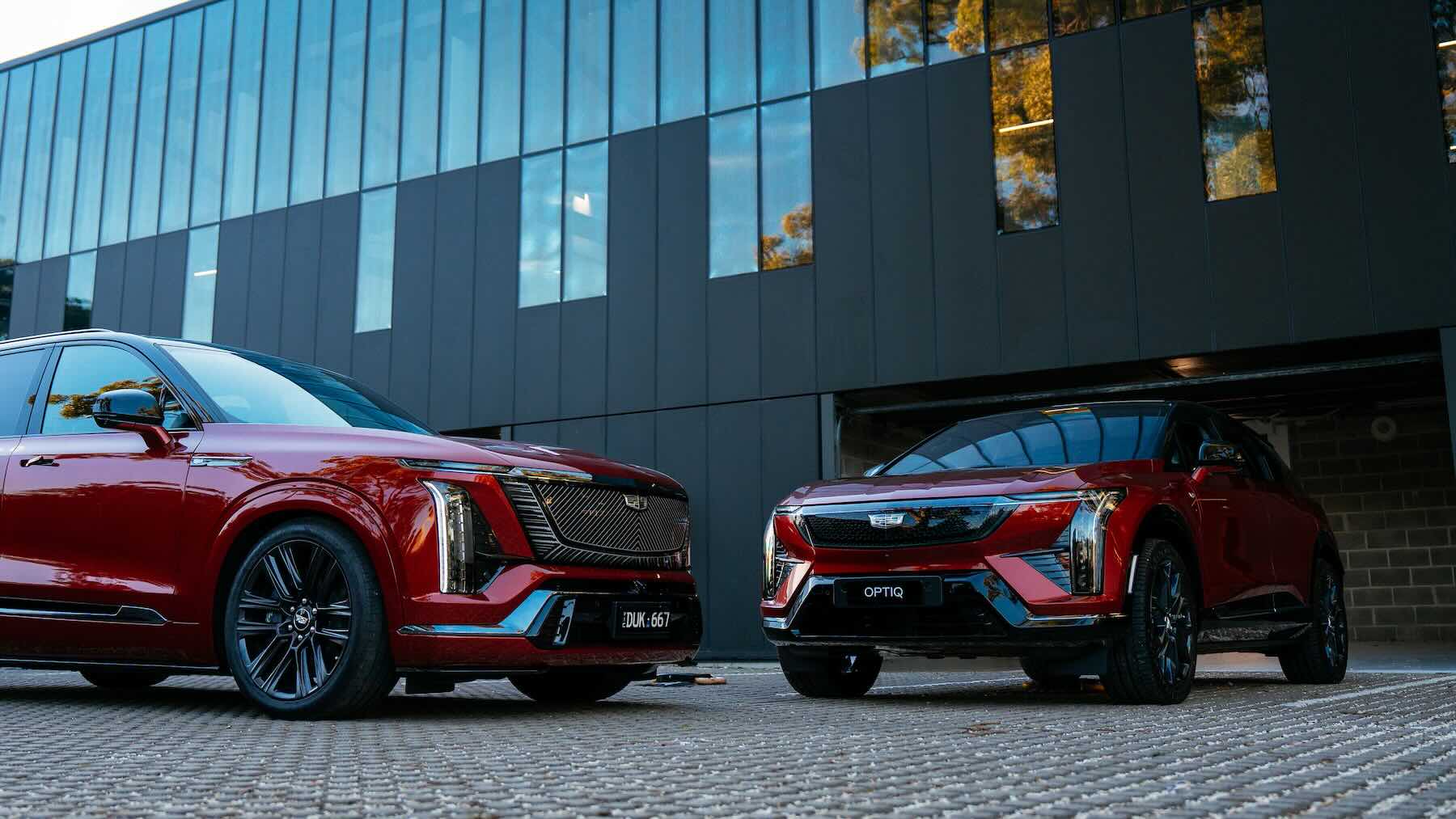
General Motors revealed the new Optiq and Vistiq in Melbourne in March, ahead of Cadillac’s inaugural Formula One race, with the two SUVs joining the existing Lyriq to create a more complete electric luxury range.
“The launch of the Optiq and Vistiq marks the next phase of Cadillac’s expansion in Australia and New Zealand,” GM Australia and New Zealand managing director Jess Bala said at the time.
The Driven was on hand at the Cadillac Experience Centre in Sydney to get a first look at both vehicles.
The five-seat Optiq is priced from $80,000 before on-road costs and is intended to serve as Cadillac’s more accessible entry point, while the six-seat Vistiq starts from $116,000 and sits at the opposite end of the range as a large, three-row family SUV.
The Optiq is positioned as the sportier and more manageable option, while the Vistiq is an imposing luxury SUV with significantly more passenger space, power and road presence.
Cadillac say they are not trying to compete directly with Australia’s highest-volume electric vehicles. Even the Optiq, its least expensive local model, begins at a price well above mainstream electric SUVs such as the Tesla Model Y, BYD Sealion 7 and Zeekr 7X.
Instead, Cadillac is looking for buyers attracted to its styling, rarity and American identity, which could be both an advantage and a limitation.
The arrival of numerous new EV brands has arguably made Australian buyers more willing to consider an unfamiliar badge. Cadillac also has the backing of General Motors, factory-built right-hand-drive vehicles and a genuine global luxury heritage, rather than being an entirely new manufacturer attempting to create a premium identity from scratch.
However, history alone will not sell cars in a market where most buyers have never owned a Cadillac and may not have seen one on an Australian road. The company must establish what a modern Cadillac represents while simultaneously persuading buyers to take a chance on a relatively small retail and servicing network.
The Optiq and Vistiq show how it intends to do that, through bold exterior design, highly equipped interiors, strong electric performance and vehicles that look markedly different from their rivals.
Cadillac describes the Optiq as a compact luxury SUV, although it is not especially compact by Australian standards.
At 4820mm long, it sits firmly in medium-SUV territory and is slightly longer than several of Australia’s most popular electric SUVs. It only appears genuinely small when parked beside the 5233mm-long Vistiq.
The Optiq’s lower roofline, shorter body and sharper proportions give it a more athletic appearance than its larger sibling. Cadillac’s familiar vertical lighting signature remains, along with the large black front panel, heavily sculpted bodywork and animated exterior lighting that runs through a sequence as the driver approaches or leaves the vehicle.
The design is a modern interpretation of the visual excess for which Cadillac was once known.

There are no towering chrome bumpers or enormous tailfins, but the brand is still attempting to make its vehicles visually theatrical rather than restrained. That could help it stand apart in a luxury EV market where shared design trends have made some vehicles increasingly difficult to distinguish.
The sole Australian Optiq is based on the Sport trim and receives 21-inch Dark Android alloy wheels, Brembo front brakes, black exterior detailing and what Cadillac calls its Black Crystal grille.
Inside, A curved 33-inch LED display stretches from the driver’s side across the centre of the dashboard, combining instrumentation and infotainment within a single panel. Cadillac says it can display more than one billion colours at up to 9K resolution.
Google Maps, Google Assistant and Google Play are built into the vehicle, although wireless Apple CarPlay and Android Auto are also available for owners who prefer to use their phones.
The Optiq also receives a 19-speaker AKG audio system with Dolby Atmos capability – which Cadillac sees as a major differentiator with other premium EVs – as well as active noise cancellation, a panoramic glass roof and heated, ventilated and massaging front seats.
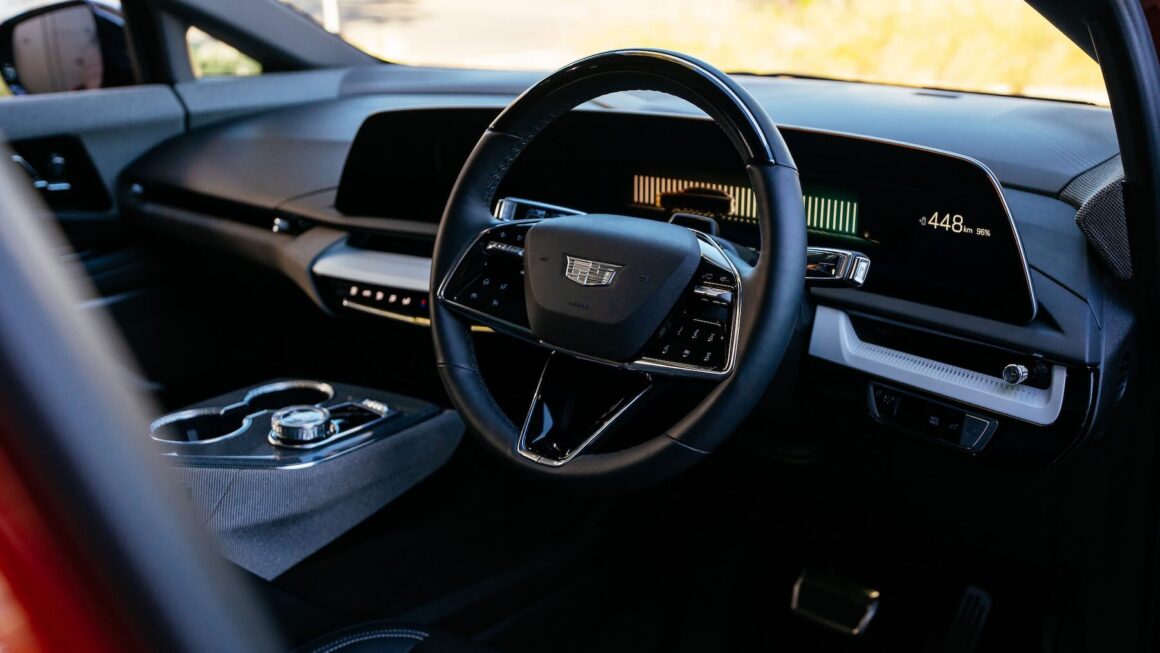
The cabin uses a mixture of fabric, textured surfaces and synthetic leather rather than covering everything in conventional black trim. Some of the patterned accent fabric is made from recycled yarn, while 126-colour ambient lighting allows different areas of the cabin to be customised.
I found the rear-seat space a little small for someone of my height (6″5), with my head hitting the roof. In the boot Cadillac claims 744 litres of cargo capacity behind the second row and 1603 litres with the rear seats folded.
Power comes from a dual-motor all-wheel-drive system producing 224kW and 480Nm, offering 0-100km’h in 6.3 seconds. A 75kWh battery provides an estimated driving range of up to 425km, with claimed energy consumption of 19.9kWh/100km.
All there of Cadillac’s electric SUVs offer genuine one-pedal capability, including a regen on Demand function, allowing the driver to increase regenerative braking through a paddle behind the steering-wheel.
Its maximum 110kW DC charging rate is relatively modest by 2026 standards, particularly for an $80,000 electric SUV. Cadillac describes the charging performance in terms of range added, claiming around 94km can be recovered in approximately 10 minutes under suitable conditions.
However, the Optiq can accept up to 22.1kW from a compatible three-phase AC charger, adding a claimed 100km of range per hour. That is considerably stronger than the 11kW AC limit fitted to many rival EVs, even if relatively few owners will have access to 22kW charging at home.
Where the Optiq is intended to be relatively approachable, the Vistiq is significantly larger. Think EV9 or Ioniq 9 size.
It measures 5233mm long, 2026mm wide and 1799mm tall, riding on a 3094mm wheelbase, which actually makes it longer and wider than a Kia EV9 and places it among the largest electric passenger vehicles available in Australia.
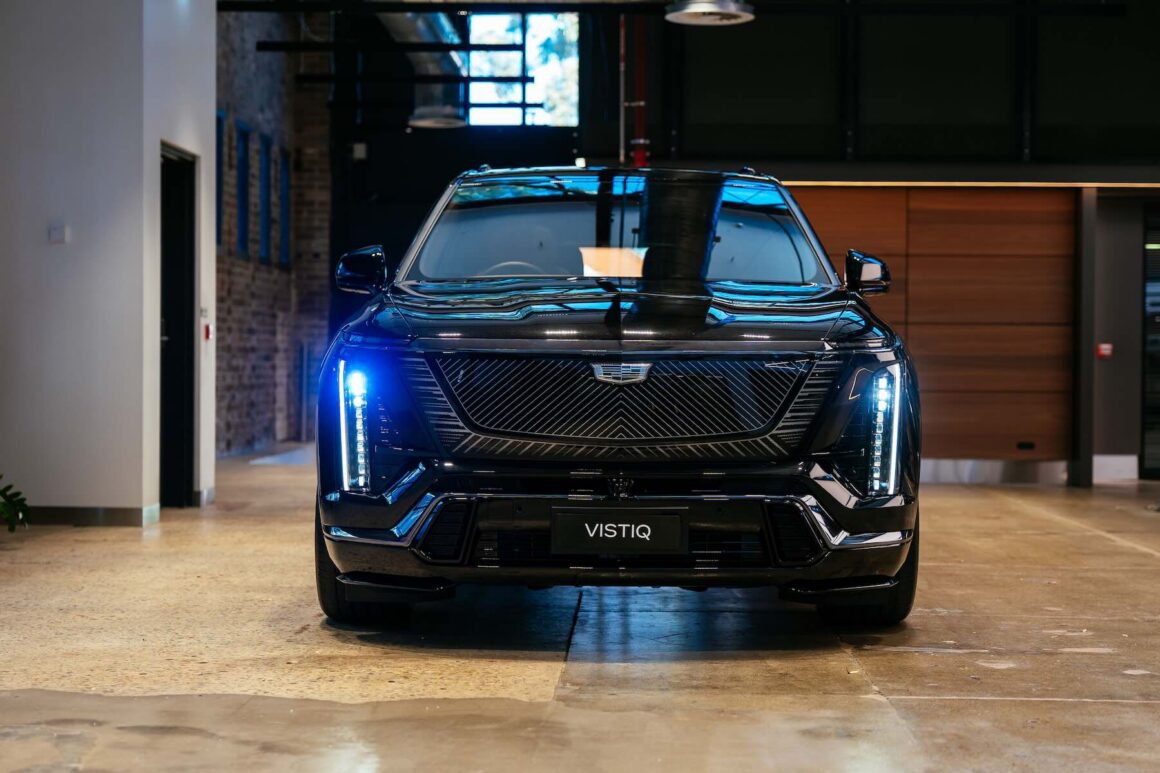
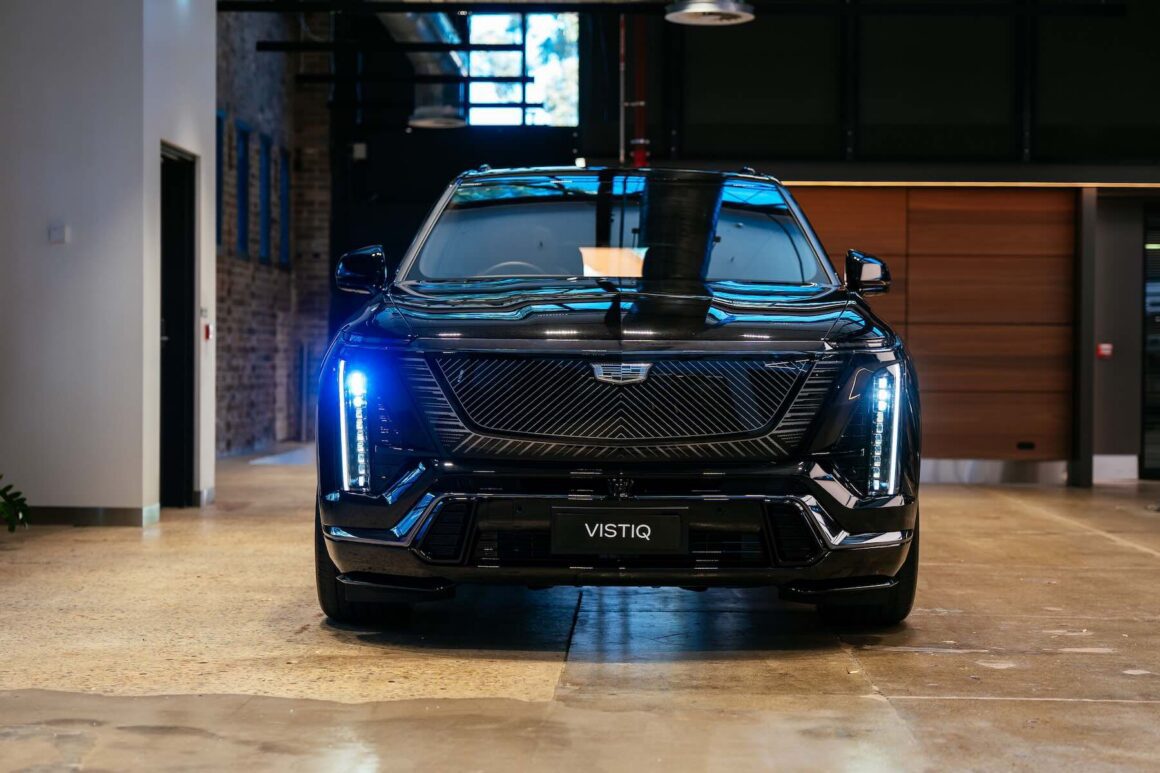
Of the two new models, the Vistiq is arguably closer to the Cadillac image familiar from American popular culture.It is large, powerful, heavily equipped and designed to make an impression.
Although it is not an electric version of the Escalade, it occupies a similar conceptual space as a luxury family vehicle that makes little effort to disguise its size or presence. That gives it relatively few direct competitors in Australia.
The Kia EV9 offers three rows and similar exterior dimensions at a lower price, while the Volvo EX90 and Mercedes-Benz EQS SUV occupy more traditional premium territory. Other large electric SUVs are available from newer brands, but arguably few combine six seats and this level of performance, not to mention Cadillac’s distinctly American styling.
Australia receives the Vistiq in high-specification Platinum trim, with body-coloured wheel arches, unique front and rear lower fascias, a black roof and a panoramic dual-pane sunroof.
There is also a separate fixed glass panel above the third row, helping bring natural light into the back of what could otherwise feel like a very enclosed cabin. The Australian configuration has six seats arranged across three rows, with two individual captain’s chairs in the second row.
This creates a central walkway into the back and gives the middle-row passengers more space and separation than a conventional bench would provide. Cadillac also describes the third row as adult-sized, although that will need to be tested properly once we spend more time with the vehicle.
Boot capacity is a useful 430 litres with all three rows in position, increasing to 1218 litres with the third row folded and 2271 litres when both rear rows are down.
Four-zone climate control allows passengers in different parts of the vehicle to adjust their own settings, while the front occupants receive heated, ventilated and massaging seats.
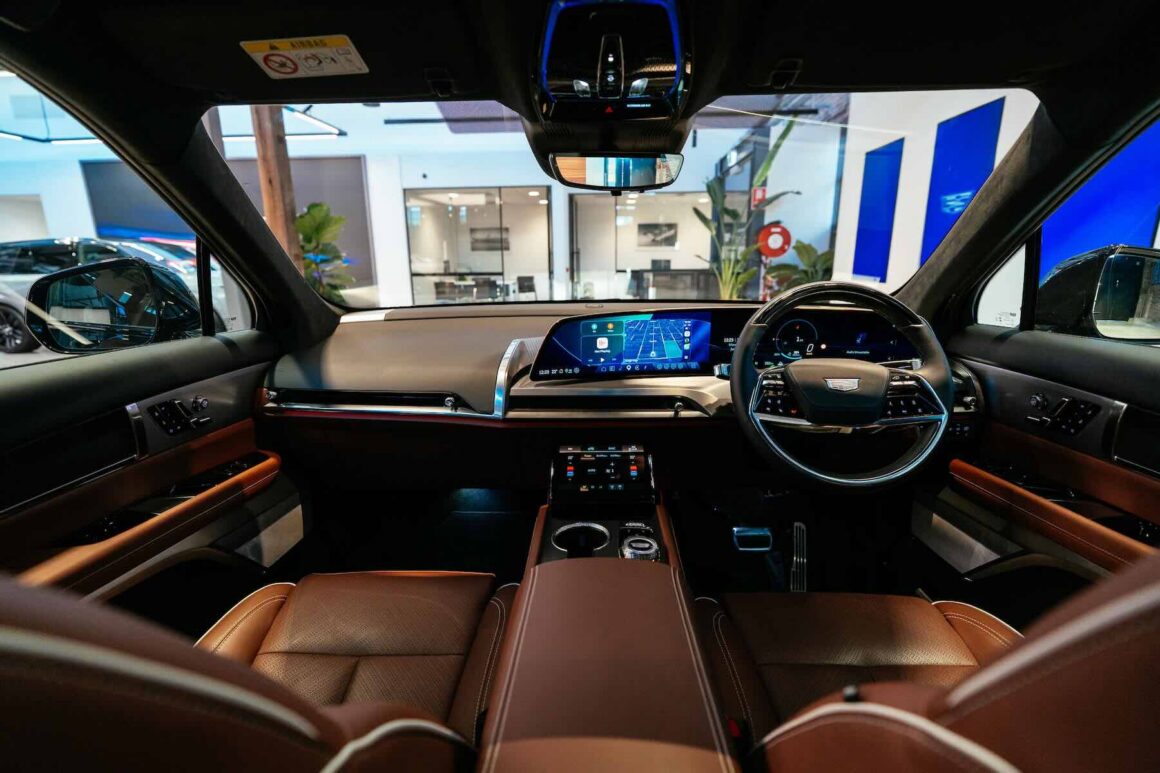

The Vistiq uses a considerably more powerful dual-motor all-wheel-drive system producing up to 459kW and 880Nm. Selecting its Velocity Max mode enables a claimed zero-to-100km/h time of 4.2 seconds, an pretty extraordinary figure for a vehicle of this size and purpose.
The rear wheels can turn in the opposite direction to the fronts at lower speeds, reducing the turning circle and helping the vehicle feel less cumbersome in car parks and narrow streets. At higher speeds, the system can improve stability by steering the rear wheels in the same direction as the fronts.
A 91kWh usable-capacity battery provides up to 461km of estimated range, with claimed consumption of 22kWh/100km. That range is reasonable for such a large and powerful vehicle, although it falls short of the figures offered by some long-range luxury EVs.
DC charging peaks at 130kW, with Cadillac claiming approximately 104km can be added in 10 minutes. As with the Optiq, that maximum charging speed is acceptable but doesn’t stand out again some of the faster new electric vehicle platforms. The Vistiq does at least retain 22.1kW three-phase AC charging, which can add a claimed 95km of range per hour under suitable conditions.
The Vistiq also adds equipment including night vision, driver-attention assistance, side bicyclist alert and a rear-seat reminder.
Between the two, the Optiq appears likely to be the volume model. It offers a distinctive interior, generous equipment and strong performance in a package that should remain manageable in Australian cities and suburbs.
The Vistiq is a more specialised proposition: a huge, extremely powerful three-row SUV aimed at larger families or buyers who want something more imposing and less familiar than the established luxury alternatives.
Without the dealer footprint and model range of other brands, and a price well above the busiest part of the Australian EV market, Cadillac would acknowledge neither the Optiq or Vistiq is likely to become a high-volume electric vehicle.
But high sales volume may not be the immediate objective. Cadillac’s opportunity is to occupy a niche between the established European luxury brands and the rapidly growing group of technology-focused EV manufacturers.
It can offer buyers something with genuine heritage and the backing of one of the world’s largest car companies, while still feeling rare and unconventional on Australian roads. Its challenge will be proving that this combination is worth luxury-car money.
Sign up for The Driven’s free daily newsletter and get the latest EV news and analysis delivered straight to your inbox.